- All updates
Papers28 Oct
Record-breaking snakes
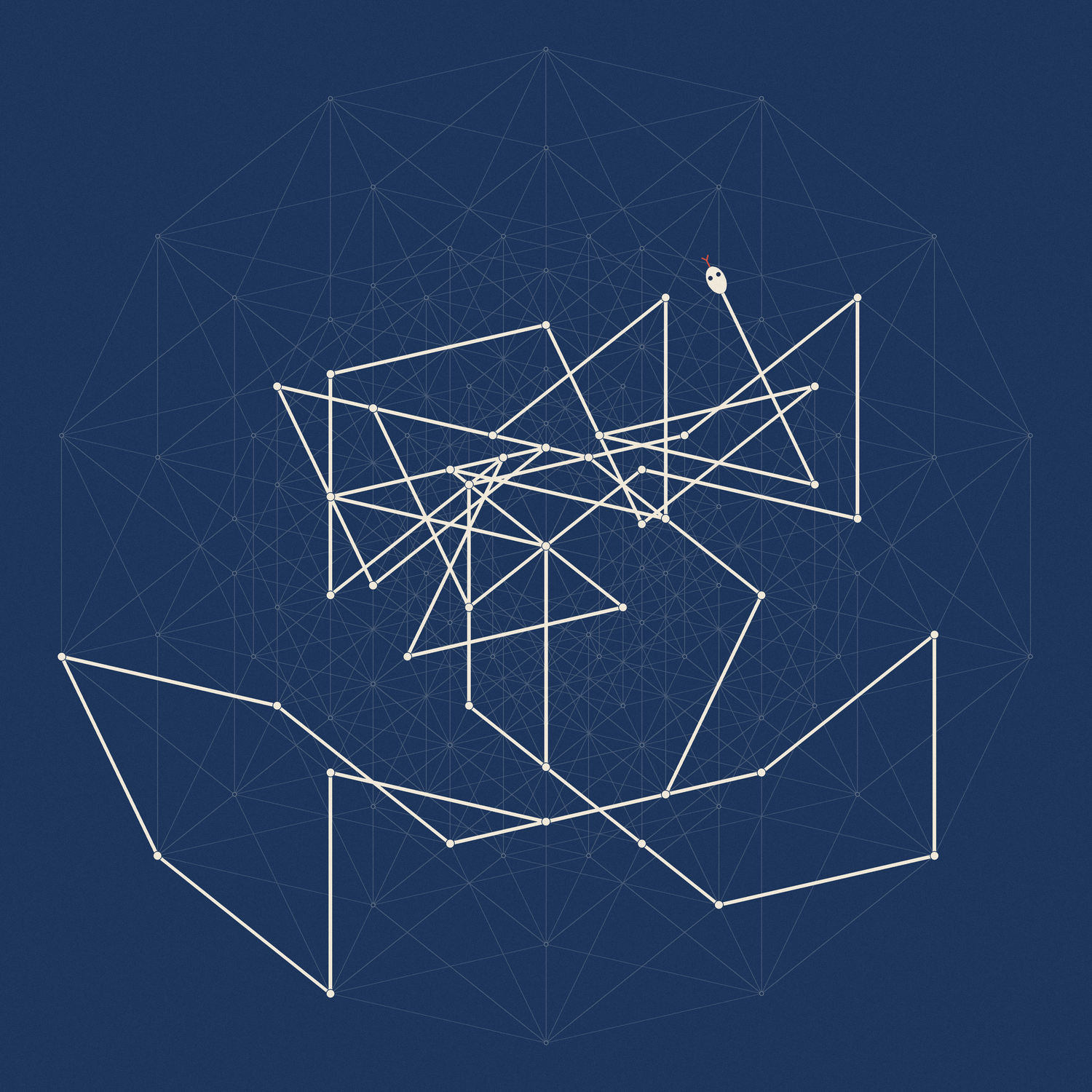
Induced paths in hypercubes, or ‘snakes’, of record length are found using novel search methods built for difficult long-horizon problems.
Eventscoming 11 Nov
Infinite cat maps
Anton Kapustin derives the second law of thermodynamics from deterministic reversible dynamics and shows why the quantum case is harder.
Papers22 Oct
Towards optimal control
The journal Physical Review A accepts paper “Efficient computation of quantum time-optimal control” by Andrei Stepanenko and his coauthors.
Eventscoming 11 Nov
Complex surfaces
The London Institute hosts a workshop on complex surfaces focusing on non-Kähler geometry, Class VII surfaces and holomorphic foliations.
Events21 Oct
A singularity's echo
Sean Hartnoll shows how the ringing of black holes reveals chaotic dynamics near their singularities and hints at hidden mathematical order.
Press21 Oct
Mathpocalypse now
On The Economist’s Babbage podcast, Prof. Yang-Hui He talks about the fall-out from the mathpocalypse—and all the reasons to be cheerful.
Events19 Oct
What maths means to us
Geordie Williamson explores what AI’s rise reveals about how humans do mathematics, from definitions and prediction to the role of geometry.
Events19 Oct
Meet Prof. Williamson
Geordie Williamson discusses the nature of mathematical discovery, the impact of AI and the future of mathematics as a human profession.
Events16 Oct
Positive exotics
Yang-Hui He explains how to find positively sectionally-curved metrics on all 28 smooth seven-spheres, answering a question from the 1950s.
Papers14 Oct
Maximal determinants
Binary matrices achieving record-highest determinants are computed by employing reinforcement learning as a combinatorial optimisation tool.
Events12 Oct
Bootstrapping strings
Shai Chester explores how to bootstrap string theory in AdS using AdS/CFT, from conformal blocks to the first correction beyond flat space.
Press12 Oct
The spirit of LIMS
Our governor Tom Walton-Pocock on why, while Silicon Valley wilts, he’s backing the London Institute to make Faraday-grade breakthroughs.
Events9 Oct
Landau revisited
Sakura Schafer-Nameki explores how generalised symmetries extend Landau’s theory of phase transitions—and reveal where it still falls short.
Events2 Oct
The power of AR
Alexei Lisitsa makes the case that in pure mathematics, where rigour and structure are central, symbolic methods in AI remain essential.
Events1 Oct
How evolution searches
Roman Belavkin explains why mutation slows near an evolutionary optimum, while recombination can keep adaptation moving by reshuffling DNA.
Events30 Sep
Reconstructing rings
Elena Bunina shows how matrix groups retain a hidden record of the algebraic data used to build them, even when their origins are unknown.
Events30 Sep
Beyond the continuum
Boris Zilber explores whether a finite structure can approximate the continuous world, with implications for spacetime and quantum theory.
Press28 Sep
Open discovery corp.
An open discovery corporation builds an institution whose capability for discovery compounds over time while its discoveries remain open.
Papers25 Sep
Whitney revisited
A Whitney-type cusp and fold theorem is proved for general algebraic surface projections and for sparse univariate polynomial discriminants.
Events24 Sep
Making sense of S⁶
Nikon Kurnosov explains Claude’s proposed solution to the six-dimensional sphere puzzle, using Phil Engel’s geometric account of the proof.
Papers16 Sep
Cohomological beta
A new algebraic method shows beta functions arise when conformal symmetry breaks, reproducing Cardy’s formula without computing correlators.
Papers16 Sep
Arithmetic as images
Computer vision distinguishes elliptic curves from random data and predicts analytic rank by reading arithmetic patterns in digital images.
Papers15 Sep
Multicomponent flow
Strong interactions reshape transport in one-dimensional quantum gases, with unusual temperature effects and anomalous current fluctuations.
Press15 Sep
What America gets right
In Billionaire Magazine, our development director Sarah Myers Cornaby asks why Britain has given up on endowment, while America forges ahead.
Events14 Sep
Simplicity runs deep
Thomas Fink shows how a hierarchical composition naturally favours simple outputs, revealing an intrinsic Occam’s razor in layered systems.
Papers10 Sep
From Foliations to Kato
The Global Spherical Shell conjecture is proved for a class of complex surfaces with two singular holomorphic foliations, a key open case.
Press27 Aug
On rethinking research
Our director Thomas Fink talks about how and why he founded the London Institute on physicist and entrepreneur Steve Hsu’s Manifold podcast.
People19 Aug
Welcome, Zeel
Zeel Patel is a LIMS governor and President of Savaya Capital, a private family office that invests in technology across global markets.
Events19 Aug
Qubits for QFT
Jiunn-Wei Chen shows how quantum computers can turn field theory into a laboratory for particles and gauge fields coming to equilibrium.
People18 Aug
Welcome, Chris
Chris Hull is a Fellow at LIMS and Professor at Imperial College. He works on superstring theory, quantum gravity and quantum field theory.
Papers17 Aug
Mott to superconductor
npj Quantum Materials accepts paper “Superconductivity from doping symmetric mass generation insulators...” by Juven Wang and his coauthors.
Papers12 Aug
Exact hard-rod dynamics
A canonical quantum fluid model is solved exactly, revealing universal correlation patterns governed by Gaussian random-matrix ensembles.
Papers11 Aug
Analysing the vacuum
Birational methods in algebraic geometry are used to explicitly describe the vacuum structure of the Minimal Supersymmetric Standard Model.
Papers10 Aug
Three fermion families
Physical Review D accepts paper “Fermion families and Pontryagin class: Topological field theory via...” by Juven Wang and his coauthors.
People4 Aug
Welcome, Venu
Mr Goswami is a Ramanujan Junior Visitor at LIMS. His work focuses on stochastic processes and non-linear dynamics in population genetics.
Papers14 Jul
C, P and T in fractions
Charge-conjugation, space-parity and time-reversal symmetries are shown to form noncommutative groups, including the order-16 Pauli group.
Events14 Jul
Aspects of geometry
The London Institute hosts a workshop on algebraic geometry focusing on deformation theory, representation theory and birational geometry.
News6 Jul
Georgi–Glashow Prize
The London Institute is establishing an annual prize of £500 for the best collaborative research paper written by two or more of its members.
Events1 Jul
The shape of music
Music is seen as well as heard, with our governor Thore Graepel’s visualisation of sound, and a recital by acclaimed pianist Sasha Grynyuk.
Events30 Jun
Being hyperefficient
Mithu Storoni explores the science of mental performance, revealing how to cultivate productivity, creativity, focus and sustained insight.
Papers25 Jun
A Calabi–Yau toolkit
We introduce CIPro, a new toolkit that automates calculations on Calabi–Yau geometries and helps explore string compactifications and vacua.
Events12 Jun
A simpler cosmology
In a new video, Neil Turok presents a minimal paradigm for cosmology that explains the universe’s large-scale structure and dark matter.
Papers11 Jun
Physics of bundles
Canonical connections in string compactifications are computed for a broad class of bundles over Calabi-Yau manifolds by a new method.
Papers10 Jun
Transcendentality proof
The principle of maximal transcendentality is proved to all orders for the vacuum energy of a strongly interacting quantum field theory.
Press10 Jun
Unseen elegance
Our Fellow Evgeny Sobko’s research on AI-driven discovery of integrable models is featured by Nebius Science. Nebius helps support his work.
Papers10 Jun
Dynamical frustration
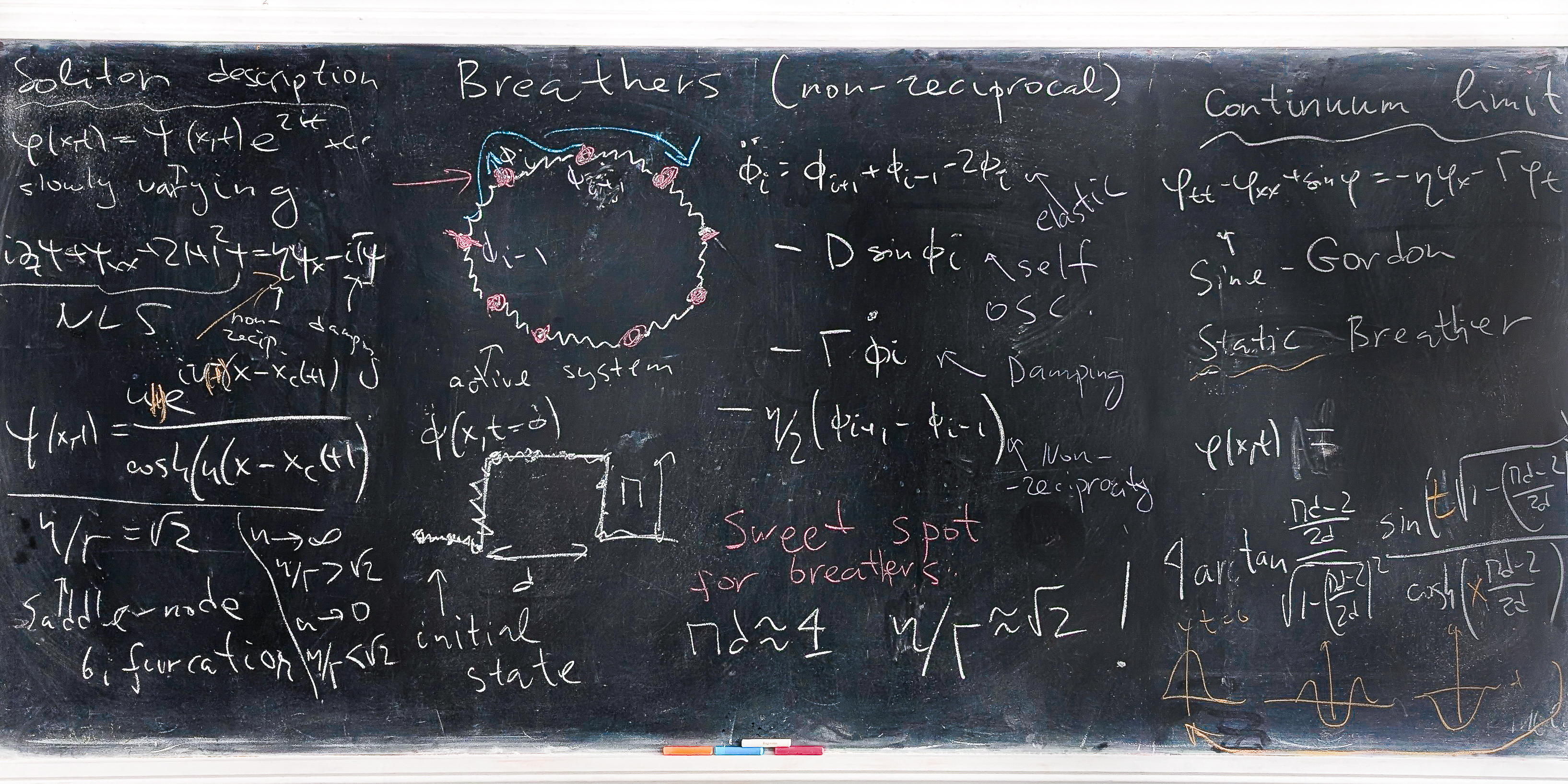
A new metamaterial composed of oscillators driven by external pumping is used to study the unidirectional drift of stable phase dislocations.
People9 Jun
Welcome, Sandra
Sandra Suits is the office coordinator at LIMS, where her duties include helping to host events and assisting our scientists and staff.
Press8 Jun
AI will augment theory
In a Nature comment, we set out how AI systems will help human scientists accelerate discovery in mathematics and theoretical physics.
Papers8 Jun
Analysing the vacuum
Physical Review D accepts paper “The vacuum moduli space of the minimal supersymmetric standard model” by Yang-Hui He and his coauthors.
Events5 Jun
Meet Neil Turok
In a new video, Neil Turok discusses the future of theoretical physics, the impact of AI and how to build institutes for fundamental science.
Papers1 Jun
Deep-layer distribution
The output distribution of a deep-layered machine with random logics exhibits a critical network depth, at which it is maximally biased.
Papers25 May
Three fermion families
A colour symmetry extension of baryon plus lepton symmetric gapped quantum topological order replaces families of massive sterile neutrinos.
People18 May
Welcome, Justin
Justin Tan is a Cognia Junior Research Fellow at LIMS. His work focuses on string theory, computational geometry and AI-assisted mathematics.
Events18 May
Frontiers of AI
Mikhail Burtsev and Yang-Hui He explore advances in AI, from long-context transformers to the impact of machine intelligence on science.
People15 May
Welcome, Devon
As well as a LIMS governor, Devon Cross is president of Logos Forums, which runs strategic simulations spanning tech, finance and security.
Events14 May
AI meets string theory
Andre Lukas shows how machine learning tackles string theory’s vast data, uncovering patterns, exploring its landscape and solving equations.
Events13 May
Meet Neil Turok
Neil Turok discusses the future of theoretical physics, the impact of AI and how to build and lead institutes for fundamental research.
Events13 May
A simpler cosmology
Neil Turok presents a minimal paradigm for cosmology that explains the universe’s large-scale structure, dark matter and the Standard Model.
Papers5 May
A new leptogenesis
We propose that dark matter consists of topological order, so gapped anyon excitations decay to generate the Standard Model's lepton asymmetry.
Papers1 May
An 8-fold way for CRT
Varying the spacetime dimensions fermions occupy shows charge-conjugation C, space-reflection R and time-reversal T symmetries are 8-fold periodic.