Fractal structures and architecture
12 Jun 2012
Rob Farr talks about the physics of architecture and how self-similar mechanical structures can make seemingly impossible designs a reality.
A fractal has the property that any part of it, when magnified, resembles the whole. Examples include the snowflake-like Koch curve and the Mandelbrot set. Remarkably, biology employs fractal designs to achieve high efficiency: spongy bone for anisotropic stiffness; ramified networks for gas exchange; and self-similar shells for pressure resistance. But in the man-made world, the reverse is true: fractal designs are rarely used for mechanical efficiency. Transmission towers and the branching columns of Gaudi’s cathedral Sagrada Familia hint at fractal design principles; but the small number of hierarchical levels and the lack of quantitative understanding suggest these are heuristic.
In this talk, Rob Farr explains how new classes of structures based on fractal designs can offer extraordinary gains in mechanical efficiency. Remarkably, they exhibit new strength-to-mass scaling behaviour, where the advantage achieved at one generation is passed on to the next. This bold shift in design philosophy offers a broad range of applications not only in the built environment but also in aerospace and space.
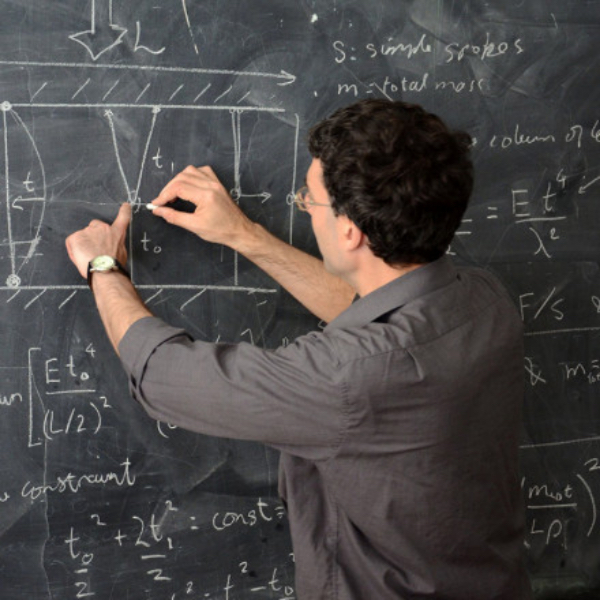
Speakers
Dr Robert Farr is an Associate Fellow at the London Institute and Senior Scientist at Jacobs Douwe Egberts. He studied physics at Cambridge and was a Senior Research Scientist at Unilever. His research interests include multi-scale and fractal systems and programmed cell death.